Legal & Compliance
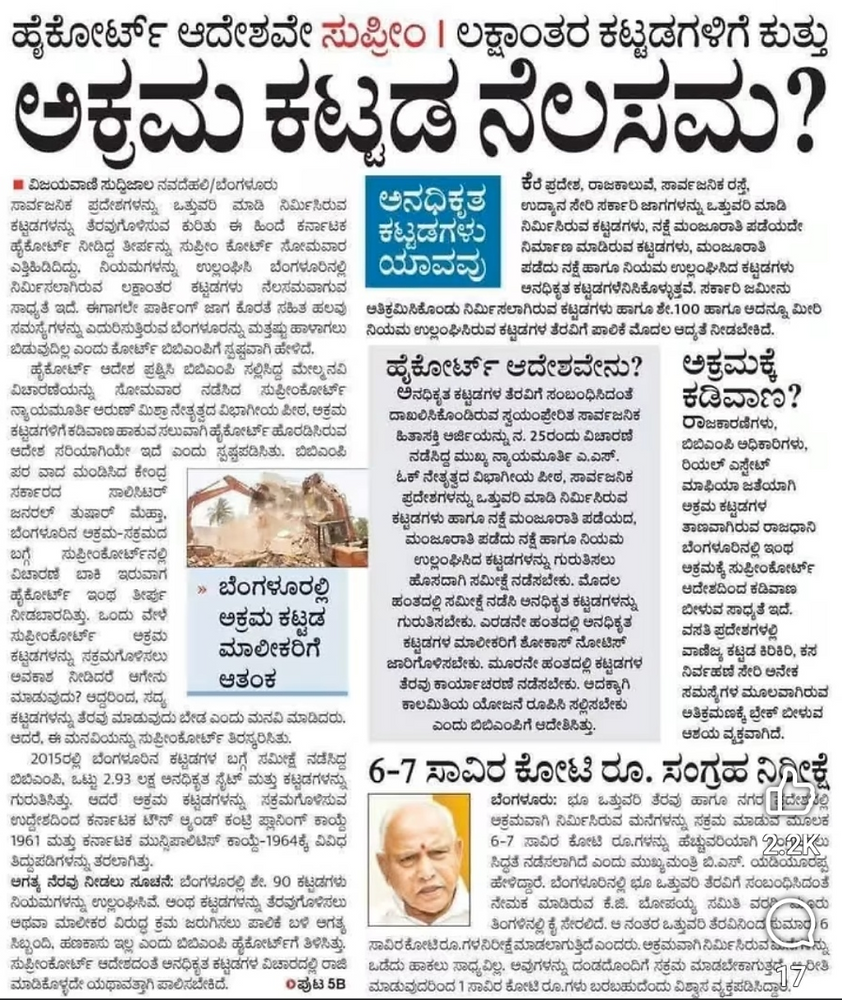
High Court Order Like Supreme Court? Will Lakhs of Illegal Buildings Be Demolished in Karnataka?

Urban development in Karnataka, particularly in Bengaluru, has been under intense scrutiny due to the growing number of
unauthorized constructions and planning violations. Recent discussions surrounding orders from the Karnataka High Court have triggered serious concerns among property owners, developers, and investors.
The question now being widely discussed is:
Will lakhs of illegal buildings across Karnataka face demolition following strict judicial directions?
Over the past two decades, rapid urbanization has resulted in a massive increase in
unapproved or partially approved buildings
across cities such as Bengaluru, Mysuru, and Hubballi.
Many of these constructions involve:
Building additional floors beyond approved plans
Violating zoning regulations
Encroaching on public land or stormwater drains
Constructing without proper approvals from civic authorities
According to various urban planning reports, the number of such structures may run into
several lakhs across Karnataka, with Bengaluru accounting for a significant portion.
The Karnataka High Court has repeatedly emphasized strict enforcement of building regulations and urban planning laws.
The court has raised concerns about:
Widespread violations of building norms
Failure of local authorities to control illegal constructions
Environmental risks due to encroachments on stormwater drains (Rajakaluves) and lakes
Legal experts note that the High Court’s stance reflects the seriousness of the issue and may lead to
strict enforcement actions if violations are proven.
One of the major questions being debated is whether
existing illegal buildings will be demolished.
In reality, authorities usually take several approaches:
In the past, the Karnataka government introduced the Akrama-Sakrama Scheme to regularize certain unauthorized constructions.
Under this scheme:
Property owners could apply for regularization
Penalties and betterment charges were collected
Buildings meeting specific conditions could become legally compliant
However, the scheme has faced
legal challenges and delays, leaving thousands of property owners uncertain about the future.
Buildings that fall into high-risk categories may face demolition. These include:
Structures built
on lake beds
Encroachments on
Rajakaluve (stormwater drains)
Constructions on
government land
Buildings violating major structural or safety norms
In such cases, authorities like the Bruhat Bengaluru Mahanagara Palike (BBMP) may initiate demolition drives after issuing legal notices.
The possibility of strict enforcement has created concern across the real estate sector.
Many homeowners worry about:
Legal complications
Difficulty in selling properties
Issues with bank loans and approvals
Developers
Developers may face increased scrutiny regarding:
Building approvals
Compliance with sanctioned plans
Land legality and zoning regulations
Investors
Investors are becoming more cautious, focusing on
legally compliant projects and verified properties.
Regularization schemes like the Akrama-Sakrama Scheme were expected to generate
thousands of crores in revenue for the state government
through penalties and regularization charges.
If such schemes remain stalled, the government could potentially lose
₹6,000–₹7,000 crore in revenue, while property owners remain stuck in legal uncertainty.
Experts suggest that resolving the issue of illegal constructions requires a balanced approach:
Strengthening
urban planning enforcement
Introducing
transparent regularization policies
Digitizing land and building approvals
Preventing future violations through strict monitoring
Without structural reforms, the cycle of
illegal constructions followed by regularization schemes
may continue.
The report says
several row houses constructed in KR Puram area near a Rajakaluve (storm water drain)
may face legal action.
Authorities reportedly checked these survey numbers because
houses were constructed adjacent to or on the buffer zone of the Rajakaluve.
Officials are verifying:
Whether the
buildings encroach on the storm water drain
Whether
building approvals were obtained
Whether the
Rajakaluve buffer zone rules were violated
If violations are confirmed:
Notices may be issued to owners
Encroached portions may be
demolished
In severe cases,
entire structures could face demolition
Rajakaluve encroachments have become a major issue in
East Bengaluru (KR Puram / Mahadevapura zone)
because:
Flooding problems have increased
Courts have ordered strict action against
drain encroachments ✅
Simple explanation:
The news claims that
row houses built near the Rajakaluve in KR Puram Survey No. 11/1–11/5 are under scrutiny, and authorities may take
demolition or legal action if they are found to be within the drain buffer zone.
💡 Since you work in
real estate / channel partner projects, this specific issue can be
very serious legally. In many such cases:
Only
compound walls or projections
get demolished
Sometimes
entire row house blocks become risky investments
50 m
35 m
25 m
If the building lies
inside these zones, it may face notices.
Conclusion
The recent developments surrounding the Karnataka High Court highlight the seriousness of unauthorized constructions in Karnataka.
While fears of mass demolitions have surfaced, the likely outcome will depend on:
Government policy decisions
Court rulings
Compliance by property owners and developers
For property buyers and investors, the situation serves as a reminder of the importance of
legal due diligence before purchasing or investing in real estate.
Get a free, no-obligation consultation with our property advisors.
 Legal & Compliance
KHB E-Auction of Residential Corner Intermediate Plots available in various Barangays developed by Karnataka H…
Read Article Legal & Compliance
Facing personal legal challenges can be overwhelming, whether it's navigating a divorce, child custody battle,…
Read Article Legal & Compliance
S.14 HMA Applies To Section 13B; Couples Can Seek Relaxation To File For Mutual Divorce Within One Year Of Mar…
Read Article