Real Estate
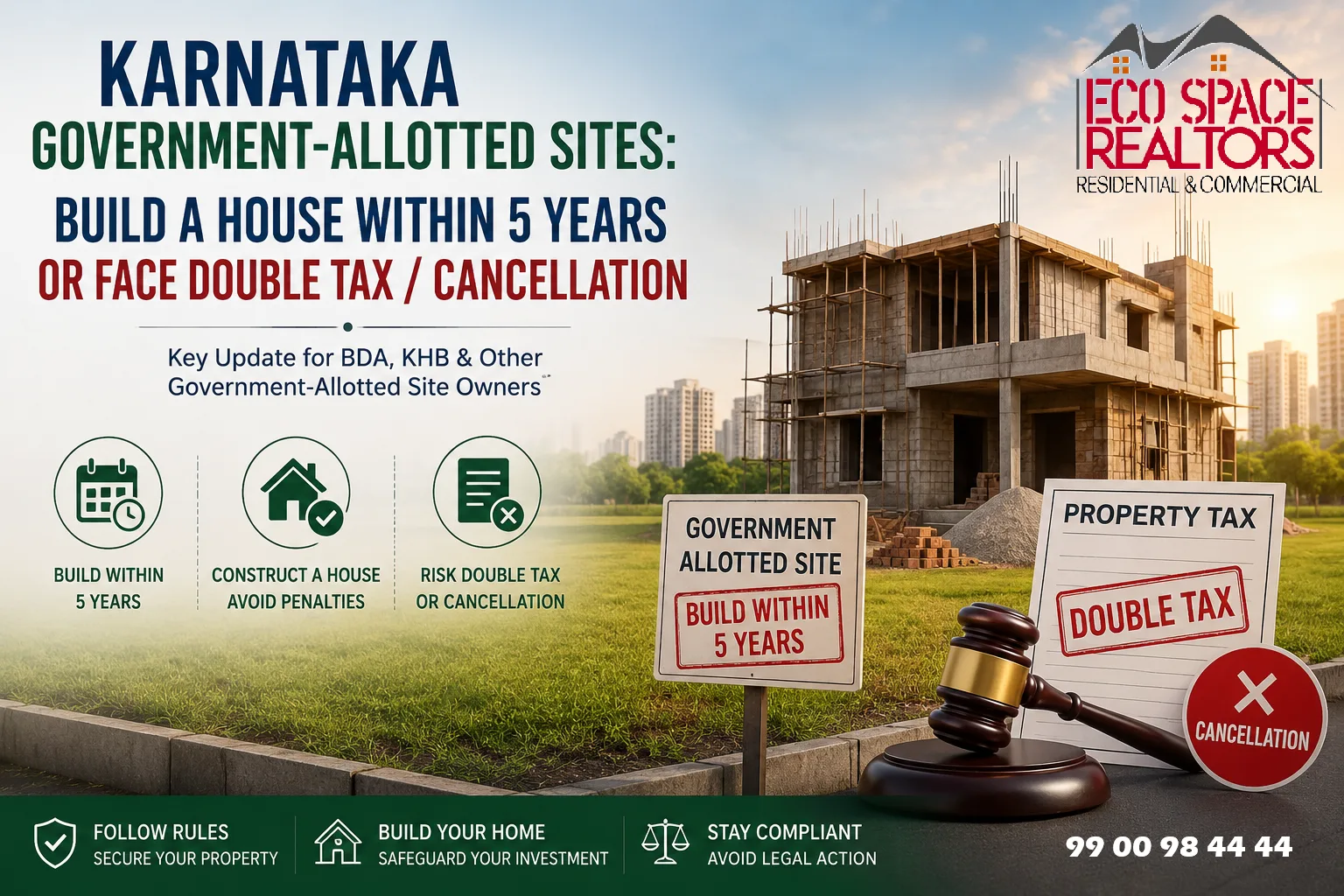
Karnataka Government-Allotted Sites: Build a House Within 5 Years or Face Double Tax / Cancellation

Owners of government-allotted residential sites in Karnataka may face stricter enforcement if they leave their plots vacant without constructing a house for more than five years.
Karnataka Chief Minister D.K. Shivakumar has stated that beneficiaries of sites allotted by government agencies should construct at least a small residential house within five years. If no construction is undertaken, the authorities may impose double property tax or initiate proceedings to take back the site, depending on the applicable allotment conditions and the authority involved.thehindu+1
The announcement is particularly relevant to owners of BDA, KHB, civic-body, and other government-agency allotted sites in Bengaluru and Karnataka. The stated objective is to prevent vacant sites from becoming places for garbage dumping, debris disposal, and neglect.timesofindia.indiatimes
Important: This is not a blanket rule for every empty plot in Karnataka. The focus is on sites allotted by government bodies, and the exact legal consequence depends on the allotment letter, sale agreement, authority rules, extensions granted, and applicable municipal regulations.
The Karnataka government has indicated that residential sites allotted by public authorities should not remain vacant indefinitely. Owners who fail to put up even a basic house within the prescribed period may face one of the following actions:
Payment of double property tax for a site that remains vacant beyond the permitted period.
Cancellation or resumption proceedings by the allotting authority.
Refund of the eligible amount after deductions or conditions specified in the allotment rules and agreement.
Notices, penalties, or other compliance action before any final cancellation action.
The Chief Minister’s statement specifically highlighted the need for at least a small house to be constructed first. Owners may later expand, redevelop, or improve the property according to approved plans and applicable building regulations.timesofindia.indiatimes
The announcement is mainly aimed at sites allotted by government agencies and public authorities.
| Type of property | Likely impact |
|---|---|
| BDA-allotted residential sites | Likely covered, subject to the allotment agreement and BDA rules |
| KHB-allotted sites | Likely covered, subject to KHB terms and project-specific conditions |
| Corporation or municipal authority allotted sites | May be covered where construction conditions apply |
| Cooperative housing society allotted sites | May be reviewed depending on the original allotment terms and authority rules |
| CITB / legacy government-agency sites | May be covered where the original allotment contains construction obligations |
| Privately purchased sites | Not the direct target of this announcement |
| Revenue sites / private-layout plots | Not automatically covered merely because the plot is vacant |
Reports on the announcement make it clear that the move is targeted at government-allotted sites, not privately owned land purchased in the open market.timesofindia.indiatimes
Not exactly. For many government-allotted sites, a construction timeline has already been part of the allotment conditions for years.
For example, BDA allotment rules require an allottee to construct a building according to approved plans within the prescribed time. The authority may, after reasonable notice and subject to the governing conditions, cancel allotment, revoke the agreement, determine the lease, and refund the balance after permitted deductions if construction is not completed within the allowed period.legitquest
The current update is important because it signals that authorities may begin enforcing these conditions more seriously, especially for long-vacant sites.
Many allottees hold sites for investment, future construction, resale, or family planning. However, government-allotted sites are often not the same as ordinary privately purchased plots. Their sale deed, lease-cum-sale agreement, possession certificate, allotment letter, and authority rules can impose additional obligations.
A buyer or existing owner should therefore not assume that “vacant land can be held forever” just because the property is registered.
This is one of the most important issues for site owners.
The five-year period may not always be calculated from the same date for every property. Depending on the authority and project, the deadline may run from:
Date of allotment.
Date of execution of the lease-cum-sale agreement.
Date of possession.
Date of registration or conveyance.
Date of a later extension granted by the authority.
For BDA sites, the construction obligation has traditionally been linked to the agreement and allotment conditions. Therefore, owners should verify the exact wording in their documents rather than rely only on a general news report.legitquest
Practical advice: Check your allotment letter, possession certificate, lease-cum-sale agreement, sale deed, and any extension order issued by BDA, KHB, or the concerned local body.
The announcement says that a site remaining vacant for over five years may be charged double property tax.thehindu+1
However, site owners should distinguish between three separate issues:
Vacant-site property tax: Tax payable on vacant land under the relevant city corporation or municipal system.
Penalty for non-construction: An enhanced levy or enforcement action related to not building within the allotment period.
Tax arrears penalty: Additional penalty and interest payable when ordinary property tax remains unpaid.
These are different matters and may arise under different laws or authority procedures. A “double tax” statement in a public announcement does not automatically reveal the calculation method, effective date, appeal process, or authority-specific notification.
Before making payment decisions, owners should wait for or verify the applicable demand notice, circular, gazette notification, BDA/KHB communication, or municipal tax assessment.
Potentially, yes—but cancellation is generally not expected to be automatic or immediate.
Under BDA allotment conditions, non-construction within the permitted period can lead to cancellation after reasonable notice, with the authority following the process laid down in the governing rules and agreement. The applicable rules also provide for deductions from the amount paid before the balance is refunded in relevant cases.legitquest
For the latest announcement, the government has indicated that it may either impose double tax or take back the plot. The actual process will depend on the concerned authority, the owner’s compliance history, any extension granted, construction status, court orders, and the terms of the allotment documents.thehindu+1
If you receive a notice from BDA, KHB, BBMP, GBA, a municipality, or another authority:
Check the property number, allotment number, and survey/site details.
Confirm the deadline mentioned in the notice.
Verify whether an extension was previously granted.
Collect proof of construction, plan sanction, commencement certificate, tax receipts, photographs, and utility documents.
Seek written clarification from the authority where the demand or allegation is unclear.
Consult a qualified property lawyer before surrendering rights, paying a disputed demand, or replying to a cancellation notice.
The public statement refers to building at least a small house. However, owners should not assume that a compound wall, shed, temporary room, excavation work, or foundation alone will necessarily satisfy the construction condition.
The safer approach is to ensure that construction is:
Sanctioned by the competent planning or local authority.
Built according to approved building plans.
Supported by proper records, including plan approval and commencement documentation.
Carried out in compliance with zoning, setback, FAR, parking, fire-safety, and local building requirements.
Capable of being evidenced through photographs, bills, inspection records, and completion-related documents.
For an authority-allotted site, an unapproved structure could create a separate compliance issue. Building without permission is not a reliable solution to a non-construction deadline.
If you own a government-allotted site, take these steps now:
Locate your allotment letter and registered agreement or sale deed.
Identify the exact construction deadline mentioned in your documents.
Check whether the property was allotted by BDA, KHB, a municipality, a corporation, or a cooperative society.
Confirm whether any extension has been applied for or granted.
Review whether the approved building plan is still valid.
Check the current property-tax status and any outstanding demand.
Inspect the site for garbage dumping, encroachment, illegal parking, or unauthorised use.
Maintain the site with fencing, signage, and basic cleanliness.
If construction is planned, begin the approval process early rather than waiting for a notice.
Obtain legal advice before buying a long-vacant government-allotted site in the resale market.
Buyers should be particularly careful when purchasing older BDA, KHB, or government-agency sites that have remained vacant for many years.
Before paying an advance, conduct due diligence on:
Original allotment letter and allottee eligibility.
Lease-cum-sale agreement and conveyance/sale deed.
Construction-completion obligation and deadline.
Any BDA/KHB extension or regularisation communication.
Transfer permission, if required.
Tax paid receipts and pending property-tax liabilities.
Encumbrance Certificate and title chain.
Khata, e-Khata, mutation, and revenue records.
Approved plan, if construction has started.
Pending notices, litigation, cancellation orders, or recovery demands.
A clean sale deed alone may not fully eliminate an unresolved allotment-condition issue. Proper legal due diligence is essential.
The announcement is aimed at sites allotted by government agencies and not at privately owned plots in general. However, private-site owners must still comply with local tax, zoning, building-permission, and cleanliness requirements.timesofindia.indiatimes
No. The announcement does not mean instant, automatic cancellation. The relevant authority must follow the applicable rules, allotment conditions, notice process, and any extension provisions.
Not necessarily. The government has signalled double tax as a possible enforcement measure for vacant government-allotted sites. The exact implementation will depend on formal orders, tax assessment procedures, and the authority concerned.thehindu
The Chief Minister’s statement suggests that even a small house should be constructed within the stipulated period, with expansion possible later. The construction must still be properly sanctioned and compliant with building rules.timesofindia.indiatimes
Immediately review your allotment and construction conditions, check for earlier extensions or notices, inspect the site, and seek written clarification from the allotting authority. Obtain legal advice before responding to any demand or cancellation notice.
This development could affect the holding strategy and resale market for old BDA, KHB, and other government-allotted sites—especially properties that have remained vacant for several years.
For sellers, documentation and compliance readiness may become more important. For buyers, a low-priced vacant site may require deeper verification of allotment conditions, construction deadlines, tax exposure, and the possibility of authority action.
Eco Space Realtors can assist buyers and sellers with preliminary property-document review, resale-site due diligence coordination, BDA/KHB property checks, and local-market guidance before a transaction.
Disclaimer: This article is for general information and does not constitute legal, tax, or investment advice. Government orders, circulars, allotment rules, and local-authority procedures may change. Please consult a qualified Karnataka property lawyer and verify the latest official communication from the relevant authority before acting.
Get a free, no-obligation consultation with our property advisors.
 Real Estate
BDA Approved & Unauthorized Layouts in Bengaluru – Important Checks Before Buying a Plot Buying a plot in …
Read Article Real Estate
Bangalore Development Authority (BDA) has announced an upcoming e-Auction of residential, commercial and inter…
Read Article Real Estate
IntroductionThe Government of Karnataka has released the draft Karnataka Apartment (Ownership and Management) …
Read Article